
By Bill Billing
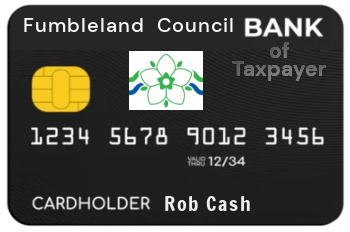
WHEN ‘Fumbleland Council’ rose phoenix-like from the smoking ruins of four abolished councils in April 2023, one of its first tasks was dishing out 260 new ‘corporate’ cards willy-nilly.
Tax-payer-funded plastic for work-related purchases was entrusted to saucer-eyed new starters and council workers moving over to the new set-up from the dissolved authorities of Allerdale, Carlisle, Copeland & Cumbria County Council.
Corporate debit and credit cards are not rare in local authorities with certain council workers and school staff having the freedom to make purchases. Most do so responsibly, keeping proper records.
But did anyone ‘high-up’ in finance ever flinch at the volume of cards in circulation? Was their attention possibly distracted by picking up the heavy accounts of four predecessor councils?
It’s unclear, but as the council finally started to notice a tsunami of unexplained credit card transactions, long overdue alarm bells finally began to ring.
HALF-A-MILLION POUNDS SPENDING SPREE
Some of the spending on council credit cards has finally been revealed in a special audit investigation, the results of which are contained in a shocking 21-page report.
It shows that in the first five months alone of the new Cumberland Council, £533,000 of debit card spending was racked up across 94 of the 260 cards given out.
Across the ‘Fumbleland 94’, 5,421 transactions were made between them. One card alone notched up £82,000 in spending.
The card of one unidentified staff member was used 897 times in just FIVE months.
Yet when auditors started a line-by-line look at what the cards were being used to purchase they couldn’t identify what was bought because 59% of the transactions had no ‘description’.
All they could find was the name of the retailer with which the card was used. And they showed hundreds and hundreds of lines of spending taking place on either Amazon or PayPal.
1,200 transactions alone were spent with 249 different ‘merchants’ accepting PayPal.
Of these, the council still can’t fully account for what was paid for in 790 transactions made on its cards via PayPal to 199 ‘unverified individuals’ – (eg not formal businesses).
The ‘unaccounted spend’ to these individuals alone amounts to £107,000.
Blackpool pleasure beach and Alton towers
In short, after much grinding of teeth, beancounters know how much money and where the money was spent, but can’t definitively account for what it was spent on, or whether this spending was “appropriate or legitimate.”
How wonderfully reassurring for loyal Council Taxpayers!
In those instances where auditors could properly identify spending, some of the transactions demand fuller clarification.
They reveal purchases made at clothes shops and jewellery counters, as well as spending at hairdressers and barbers, among others.
Transactions were also made at Argos, Alton Towers, Blackpool Pleasure Beach, a couple of national holiday camps, and even paying DVLA car tax.
The report splutters that while some of this spending may appear “superficially irrelevant to council services,” staff involved “advised that this was “legitimate spending”.
So that’s that cleared up, then!
This spending, the report says, was often on: “People within the council’s care” which includes: “Looked after children and young people leaving care”.
The report also mentions how staff had been advised to always keep their cards “securely kept”.
Yet one cardholder conveniently “left the council” before being able to account for transactions made on their card.
So does this mean social workers and teachers were generously splashing council plastic to play Father Christmas or did the credit cards miraculously leap into the possession of the wrong hands over and over and over again?
No one is daring to say.
Historically, child care is one of Cumbria’s biggest overspending council departments, with local authorities having the awful legal duty of picking up society’s tatters.
But ‘care’ shouldn’t equal bottomless pit spending.
Significant record-keeping and accounting concerns
Even internal secondary checks failed to stop the spend.
Because the card transactions had not been fully described, second liners could “not easily identify and properly record what payments related to”.
“Minimal reconciliation and journalling of transactions” was found, along with “significant concerns” around “record-keeping and accounting”.
Has anyone been sacked and what does the Labour leadership think? Is Inspector Knacker involved?
The silence might suggest so, although nowhere does the report infer or state that criminality has taken place.
Long after the horse has bolted, the council has been handed four “high priority” audit recommendations and four “medium priority” measures.
‘No one’s to blame,’ says everyone to blame?
Yet in a sign of the “no one is to blame” culture endemic in the public sector, the council seems to be suggesting that reckless high spending on its cards might be because staff need to better understand the council’s “guidance” of how to use them.
It can’t provide “evidence” they know “what” to do with a corporate credit card, you see.
That’s very disturbing.
Don’t blame me, boss, how was I to know what I was spending it on?
Long overdue “mandatory” staff training for cardholders is now one of the council’s “high priorities“. Cardholders must also agree to tougher “terms and conditions” when granted a card.
Proper signed records of this agreement must also be maintained and kept on file in case checks are required. (Was this not fully done before?)
Some corporate cards have been withdrawn from staff after no “business need was identified” and to reduce any risk of “inappropriate and inaccurate use”.
Why then, were these staff members given a card originally!
The number of purchase cards in “active” circulation in January 2024 had fallen to just 120 (140 fewer than before).
Spending limits had already been reduced on cards following ‘concerns‘.
Tighter “controls” have also been rushed through to help “safeguard council assets”.
Which begs the bleedingly obvious question – why wasn’t all this done at the outset BEFORE the cards were handed out?
Drafts of the far-from-exhaustive report have been internally doing the rounds of the council for months now, before ending up in the public domain.
The damning report has crash-landed on many well-paid senior desks, including:
Chief finance manager
Director of resources
Finance manager
Chief executive
Chief Legal Officer
Group Accountants
Interim Accountant
Procurement & Contracts Manager
Assistant director ‘customer solutions’
Promises are being made that this tightening-up of the belt will help ensure “value for money” in card spending going forward.
Many will say it’s a bit too late for that . . .
Sign up to Cumbria Chronic
Discover more from thecumbriachronic.co.uk
Subscribe to get the latest posts sent to your email.
 thecumbriachronic.co.uk